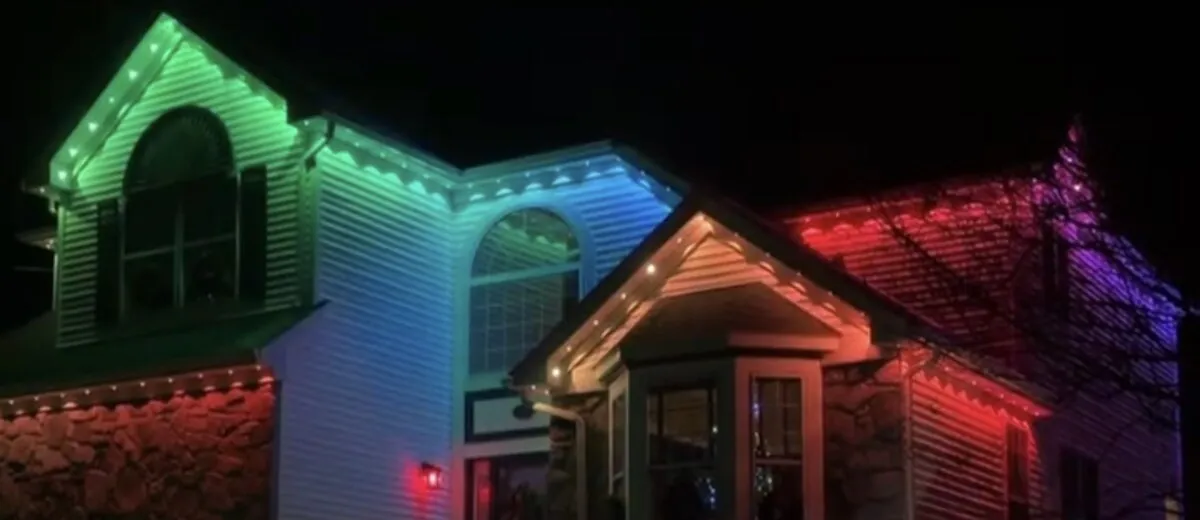
Most people picture Govee lights on a house and imagine a bright rainbow gamer setup. That's one setting. In real life, the homes we install look like a tastefully lit house 350 days a year and only go loud when the owner wants them to.
Daytime: what you actually see
The channel runs tight along the underside of the eave, fascia or soffit line. From the curb it reads as a clean trim line, and on white or light-colored trim it basically disappears. You are not looking at cords, clips or bulbs.
Night, everyday mode
Nine out of ten nights, homeowners run a single warm white around 2700K at 30 to 50 percent brightness. It outlines the roofline, adds real depth to the front of the house, and looks like architectural lighting, not a decoration. Dimming matters here — full blast looks like a car dealership.
Night, holiday mode
- Halloween: orange with a slow flicker, purple accents.
- Thanksgiving: amber and deep gold, steady.
- Christmas: alternating red and green, or all warm white for the classic look.
- Fourth of July: red, white and blue chase.
- Game day: your team's colors, which in this part of New Jersey is usually green.
- Birthdays and parties: whatever the kid picks, which will be pink.
Each bulb in the track is individually addressable, so you get patterns and segments, not just one flat color across the whole run.
How you control it
Everything runs through the Govee app on your phone: pick a scene, set brightness, and schedule it to turn on at sunset and off at whatever hour you want. It also works with voice assistants, and it'll sync to music if you're the house that does that on Halloween.
Do they hold up outside in New Jersey?
Yes. The outdoor Pro tracks are weather-rated for permanent exterior mounting and handle our whole cycle — salt air off the shore, summer humidity, freeze-thaw, snow load off the roof. The failure point on a bad install is never the LEDs, it's sloppy mounting and unsealed connections, which is exactly what you're paying an installer to get right.